ABOUT BOM SPECIES LIST BUTTERFLY HISTORY PIONEER LEPIDOPTERISTS METHODS
The Butterflies of Massachusetts
18 Acadian Hairstreak Satyrium acadica (W. H. Edwards, 1862)
The Acadian is a rather special hairstreak. Unlike our more common Satyrium hairstreaks, Coral, Edwards’, Banded, and Striped, which are forest, forest-edge, or dry scrub dwellers, the Acadian is associated with shrubby willows in open wet meadows and streamsides. It was probably one of the earliest re-colonizers of New England during the post-glacial Pleistocene. Today it is a northerly species only, lacking the southeastern U.S. distribution shown by most of our other Satyrium hairstreaks (maps in Opler and Krizek 1984; Cech and Tudor 2005). A recent study suggests it is declining in Massachusetts due to climate change (Breed et al. 2012). Its notable decline further south, at its former southern limit in New Jersey (Gochfeld and Berger 1997: 149) may be due to climate warming as well as habitat loss.
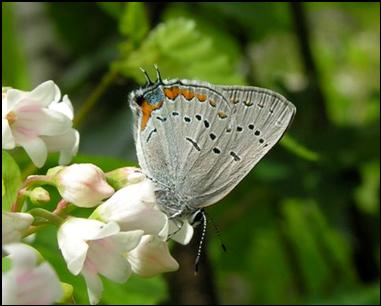
Photo: Woburn, Massachusetts, H. Hoople 7-1-2011
Acadian Hairstreak was apparently not common, and perhaps even rare, at the turn of the century here, even though one might think it would have benefited from an increase in willows during the agricultural era. Scudder cites hardly any New England locations for it, in contrast to the Banded, Striped, Edwards’, and Coral Hairstreaks. He had specimens from only two Massachusetts areas, Williamstown and Cape Cod, which he himself had taken around thickets fringing streams (1889: 901). He did list it as “known to occur in Essex County” (Scudder 1872), but cites no specimens. T. W. Harris does not mention Acadian, nor did he have any specimens in his 1822-1850 collection (Index). In fact, there are no 19th century Massachusetts specimens in the Harvard Museum of Comparative Zoology. Maynard (1886) wrote that he had “two specimens of this rare species before me which were taken in the vicinity of Boston, but I have never met with it living, in fact it does not appear to be at all common anywhere.”
Thirty years later, Farquhar (1934) adds only Amherst (C.S. Minot; specimen is at Boston Univ.) to Scudder’s list of Massachusetts locations. Root and Farquhar (1948) list no specimens in their review of the Andover region, and Jones and Kimball (1943) do not list it for Martha's Vineyard or Nantucket.
Acadian Hairstreak may actually have become more common in the 1960's and 1970's, judging from specimen and Lepidoperists' Society records, although it may be simply that hitherto unknown colonies were discovered. Records begin the 1960's for both Berkshire and Middlesex counties. For the Berkshires there are five 1961 specimens from Mt. Greylock (no collector listed) at the Smithsonian. In 1962, S. A. Hessel found a colony in Egremont (MCZ 3 specimens; Yale 2 specimens); and O. R. Taylor found specimens in Richmond (Yale). There is also a 1971 specimen from Worthington (Smithsonian, no collector), and a 1976 specimen from Windsor (R. P. Webster, McGuire). In 1980 R. Wendell Sr. took specimens from a colony in Pittsfield, and in 1995 he found one in Adams.
In the southern Berkshires D. Wagner and others found Acadian Hairstreak at Sheffield's Schenob Brook Fen in 1993 and in Ashley Falls in 1996 (specimens at UConn), and there is a 1982 Sheffield specimen at Yale (D. S. Dodge). In the Connecticut River valley, Patrick Carey reported in 1975 that Acadian was “fairly common in fresh condition in a dry field near the CATY tower in South Hadley on June 30” (Lep Soc. Seas. Sum. and Corresp., 1965-1975). In addition, there are several 1985 specimens from Amherst, Amethyst Brook Cons. Area (P. Savage, R. P. Webster, McGuire).
For eastern Massachusetts the 1960 specimens begin with one from Acton, dated 1962 (Charles. G. Oliver, Yale); subsequently in 1965-66 Oliver collected about eleven Acadian Hairstreak specimens in Acton and west Acton (Yale), and two in Littleton (1966, McGuire; 1970, MCZ). Oliver listed Acadian in 1967 as one of three hairstreaks, the others being Banded and Striped, which were common in dry old fields on Asclepias in the Acton area (LSSS 1967). A bit further south, in Ashland, M. G. Douglas found four specimens in 1963 (McGuire), and W. D. Winter found at least one specimen in Westwood in 1969 (MCZ). Daryll Willis also reported Acadian Hairstreak in 1973 and 1974 in the Holliston-Sherborn-Framingham area, saying that he took 12 specimens in 1973 (LSSS 1973, 1974).
North of Boston in the 1970's, Robert Robbins found a colony of Acadian Hairstreak in Woburn, in the vicinity of Horn Pond Mountain. He took seven specimens in 1975 and 1976 (Smithsonian). And south of Boston, in the 1980's Mark Mello discovered a colony near New Bedford (earliest specimen 1984, Mello collection). This colony was monitored for several year through the Xerxes Counts; 11 were counted in 1987, 40 in 1989, and 16 in 1990 (see below for later reports).
Host Plants and Habitat
Acadian Hairstreak's larval hosts are many willows, including black willow (nigra), pussy willow (Salix discolor), silky willow (Salix sericea), and beaked willow (Salix bebbiana) (Scott 1986), all of which are native to, and found in, every county in Massachusetts (Dow Cullina et al., 2011). The 1995-99 Connecticut Atlas found eggs or larvae on black willow in the wild in that state (O'Donnell et al. 2007).
These willows, especially black and pussy, are widespread in Massachusetts, so the scarcity of the butterfly today is somewhat surprising, and may have to do more with climate or some other aspect of habitat, such as the availability of nearby nectar sources or the presence of suitable ants. The butterfly is almost always associated with willow-bordered wetlands, such as wet meadows and streamsides, but may often be found on flowers at nearby, drier sites, such as a dry rocky hilltop in Woburn (see photo above). Nectar sources include milkweeds, dogbane, and New Jersey tea.
Relative Abundance Today
Both MBC and earlier Atlas records rank Acadian Hairstreak as Uncommon (Table 5). The Atlas found it in 30 out of 723 blocs searched.
Acadian Hairstreak may be declining in Massachusetts, or at least is subject to great population fluctuations at its few known locations. Chart 18 shows an overall decline between 1992 and 2009. This result depends greatly on the high index reading for 1992, which mainly reflects high counts at the two best-known colonies: New Bedford area (41) and Pittsfield (26). Then in succeeding years numbers at both colonies dropped, but showed a resurgence in 2004 and 2005.
A separate analysis of the same 1992-2010 MBC data, which used list-length rather than number of trips as a proxy for effort, and did not rely on counts of individual butterflies, found a statistically significant 82.5% decline over these years. In that study, Acadian Hairstreak had the second largest decline among all Massachusetts species in detection probability. It, Aphrodite Fritillary and Atlantis Fritillary are the three species with the greatest declines. All are northern-based species (Breed et al., 2012).
Chart 18: MBC Sightings per Total Trip Reports 1992-2009
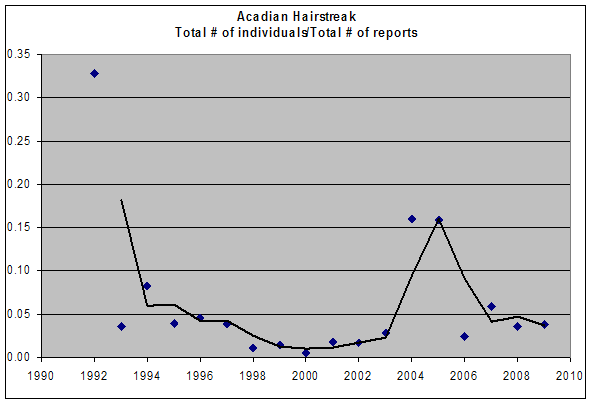
The number of individuals per total trip reports shown in Chart 18, as well as the number of sightings per total trip reports containing that species (chart not shown), both show the same pattern: a marked increase in 2004 and 2005, and a downward trend 2005-2009.
A decline in 2008 and 2009 from the highs of 2004 and 2005 is also evident in calculations of percentage decline from prior years. In 2007 the average number of Acadians per report of that species increased 43% compared to the average for preceding years back to 1994. But in 2008 and 2009 the average declined 25% and 19% respectively, compared to prior years. The number of reports of this species also declined in each of these three years compared to prior years. The declines are especially notable in contrast to the increases for Coral Hairstreak (Nielsen, Season Summary, MB 2008-2010, Nos. 30, 32, 34).
State Distribution and Locations
Map 18: BOM-MBC Sightings by Town, 1992-2013
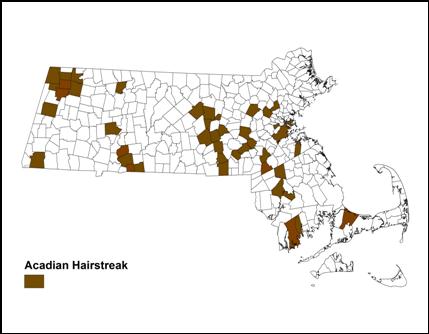
In 22 years of MBC records 1992-2013, Acadian Hairstreak was found in 41 out of 351 towns (Map 18). The map shows three main areas for Acadians: the Berkshires, the Connecticut River valley, and from the Worcester area through eastern and southeastern Massachusetts. This hairstreak was not been found in these years in Essex County or on Martha's Vineyard or Nantucket.
Both Map 18 and the earlier MAS Atlas show Acadian Hairstreak well-distributed in central, southern and northern Berkshire County, as one would expect from the historical record. On the Central Berkshire NABA Counts, Acadian Hairstreak has been found in good numbers nearly every year from 1992-2011; a high count of 134 was reported 7/17/2005, and the next highest total was 53 in 2007. But there were only 26 in 2009, 12 in 2010, 10 in 2011, 1 in 2012 (but 24 two weeks earlier), and 14 in 2013, so numbers appear to be declining. The Southern Berkshire NABA Counts found Acadian every year 2003-2008 in small numbers, but did not report it in 2009, 2010, 2011, 2012 or 2013. The Northern Berkshire NABA Counts found Acadians in very small numbers in 1994, 1995, 2004, 2007, 2011 (including Mt. Greylock), and 2012 (1, Williamstown, B. Zaremba and P. Weatherbee). From Count data, numbers in the Berkshires, as in the state as a whole (Chart 18), seem to be in a downward phase.
For the Connecticut River Valley, contemporary records are few, and mostly from the 1990's. The latest are Greenfield (1, 7/7/2001, Central Franklin NABA), Northampton (1, 7/13/2000, T. Gagnon), and the Springfield area (4, 7/15/1995, and 1, 7/15/1999, Lower Pioneer Valley NABA). There are no records for "the valley" more recent than these. There are two records from Chicopee Westover Air Base (M. Mello, 7/2/1994; T. Gagnon 6/22/1996), and earlier reports from East Longmeadow and Hampden.
For the central towns around the Quabbin Reservoir, MBC, like the Atlas, has no Acadian records, although it seems likely the species would occur there. For the Worcester area, and to the east and south of Worcester, MBC, like the Atlas, does have records, but these are nearly all from the 1990's and are of low numbers (1-2 per report). The most recent record is from 2008: 2 found on the Blackstone Valley NABA Count. This Count reported 2 to 3 Acadians each year 2001 through 2005 (e.g. Grafton Dauphinais Park 3, 7/12/2005, D. Price), but has not reported any Acadian Hairstreaks 2009-2013.
In Norfolk and upper Bristol County (southeastern Massachusetts), the Foxboro NABA Count reported Acadians regularly 1992-2000, before the Count was discontinued. Some specific towns from this Count area are Walpole, 5 on 7/11/1993, T. Dodd; Easton, 7, 7/2/1994, B. Cassie; Taunton, 3, 7/19/1997, B. Cassie; and Milford power line, 5, on 7/4/2001, R. Hildreth. The latter is the latest report from this area.
In southern Bristol County Acadian Hairstreak does still occur in a well-known colony near New Bedford (54 individuals counted 7/17/1994; but 12 on 7/19/2005). This colony was reported from the 1980s through 2005 (see above), but none were reported between 2005 and 2012, despite searches, because the colony declined markedly as a result of a well-intentioned wetland restoration project. But finally, in 2012, a dozen Acadian Hairstreaks were re-located at that site (July 6, 2012, M. Mello), nectaring on dogbane and narrow-leaved mountain mint. There is also another small colony in the Dartmouth area, from which one was reported on 7/8/2012, M. Mello. MBC records do not show Acadian Hairstreak to be “common” in Bristol County, as the Connecticut Atlas put it; MBC and NABA records refer solely to these two small colonies.
For Essex County, MBC does not have any Acadian records, and there are apparently none since 1990, when the MAS Atlas found it in Beverly (7/14/1990, T. French), Haverhill (7/4/1989, T. French), and Reading (7/8/1989, S. Goldstein). These areas should be re-checked.
The only report from Cape Cod is from Sandwich, Massachusetts Military Reservation, where a recent survey (7/16/2011, E. Nielsen and P. Trimble) found 43 Acadian Hairstreaks amid many Edwards' and Banded. This area is closed to the public. This is the first report of Acadian Hairstreak from Cape Cod since Scudder's day (the Atlas did not find it on the Cape), and this colony ought to receive monitoring and protection.
Acadian has not been reported from Martha’s Vineyard or Nantucket by MBC or the Atlas or other sources (Pelikan 2002; LoPresti 2011). Jones and Kimball (1943) do not list it as present historically on these islands.
NOTE TO COLLECTORS: Due to its uncommon and possibly declining status here, collectors should refrain from taking specimens of this butterfly. Some locations have been omitted from the discussion above to deter amateur collecting.
Broods and Flight Period
All of our Satyrium hairstreaks have a single flight mainly in July, and the Acadian is no exception. Peak reports are usually the second week in July (http://www.naba.org/chapters/nabambc/flight-dates-chart.asp). However, in the warm spring/summer of 2012 the peak numbers at the Pittsfield colony were recorded on June 24, and declined after that (T. Gagnon, pers. com.).
Earliest Sightings: In the 23-year period 1991-2013, the five earliest "first reports" in MBC records are 6/21/2010 Woburn, R. and S. Cloutier; 6/21/1998 Grafton D. Price and D. Small; 6/22/1991 Worcester BMB, T. Dodd; 6/23/2012 Woburn, S. Moore et al.; 6/27/2004 Woburn, M. Rines. The first sighting date in 2013 was 6/29/2013 Pittsfield, T. Gagnon.
Flight Time Advancement: A century ago Scudder wrote that this butterfly "generally appears about the 10-15 July, although it sometimes occurs as early as the very end of June" (1899: 902). The geographical latitude to which Scudder was referring is not clear, but usually included Massachusetts. Given that Acadian Hairstreak's first appearance in Massachusetts is now usually in the third or fourth week of June, one might suspect that its flight period had advanced since Scudder wrote.
Analysis of BOM-MBC and Atlas sight data 1986-2012 shows that Acadian Hairstreak has advanced its flight date about 8 to 10 days over this time period (Williams et al. 2014). All ten elfins and hairstreaks examined had advanced flight dates somewhat, with elfins advancing more than hairstreaks. An earlier study at Boston University, which looked at Atlas and MBC sighting data for 1986-2009, did not find that Acadian Hairstreak had advanced its flight time over that time period (Polgar et al. 2013), but addition of newer data revised the analysis. Polgar et al. also showed that, like most elfins and hairstreaks, Acadian Hairstreak emergence times were highly responsive to average temperatures in the two months preceding emergence.
Latest Sightings: In the 23-year period 1991-2013, the five latest MBC "last observation" dates are 8/12/1992 Easton, L. Lovell; 7/27/1995 Savoy D. Potter; 7/26/1997 Pittsfield T. Tyning et al.; 7/25/1993 Worcester BMB T. Dodd; and 7/24/2005, Berkshire Co., B. Benner.
Scudder's rather vague flight ending date was "until the end of the first week in August, perhaps longer" (1899: 902). In all of 23 years, MBC records contain only two sighting in August, that from Easton noted above, and 8/2/1992, Worcester BMB, T. Dodd. Scudder's dates may be meant to include localities further south of Massachusetts.
Outlook
The Acadian Hairstreak's center of gravity is northern damp meadows; it is most secure in the northern mid-continent areas of the U.S. and Canada. In the east, it reaches the southern edge of its range in Pennsylvania and New Jersey, and it is vulnerable in these areas, where climate warming may induce a withdrawal westward and northward.
Two studies indicate that Acadian Hairstreak is declining here, and it has already undergone a decline in New Jersey. Despite repeated searches, it has not been seen there since 2006, and is now under state review (Wander and Wander, 2009). Acadian Hairstreak may also be declining in Connecticut. In the 1990-95 Connecticut Atlas, there were only 19 project specimens, compared to 41 pre-project specimens. Also, it appeared to be gone from some former areas in the eastern part of the state. In Rhode Island, Acadian is ranked S2S3 or “imperilled” (NatureServe 2010).
Acadian Hairstreak is listed here as a Species of Conservation Concern in Massachusetts. It is already scarce on the southeastern plain, and if climate warms further, we could see a range contraction northward and westward, and contraction to higher elevations, in the state (Table 6). Climate warming appears to be the main threat, but urban/suburban development, forest re-growth, pesticide spraying, and indiscriminate collecting can also adversely affect this species. Very few of the known colonies are on protected land.
The four largest known Acadian Hairstreak colonies-- Sandwich Mass. Military Reservation, New Bedford, Woburn, and Pittsfield --should be protected from development, should be monitored yearly, and should be managed to deter forest succession and preserve host plant willows. Searches need to be undertaken to locate and protect the lesser-known breeding areas in the northern Berkshires. Acadian Hairstreak’s 2010 NatureServe rank is S4 in Massachusetts, but this needs review given the indications of decline here.
© Sharon Stichter 2010, 2011, 2012, 2013, 2014
page updated 11-12-2014
ABOUT BOM SPECIES LIST BUTTERFLY HISTORY PIONEER LEPIDOPTERISTS METHODS