ABOUT BOM SPECIES LIST BUTTERFLY HISTORY PIONEER LEPIDOPTERISTS METHODS
The Butterflies of Massachusetts
44 Silver-bordered Fritillary Boloria selene (Denis and Schiffermüller, 1775)
“From the middle of June until late in September, the pretty, little Silver-bordered Butterfly may be seen making its way leisurely, among the grass and herbage in the meadows. [It is] very fond of feeding upon the flowers of the white clover, and may be found flitting over this plant wherever it occurs in the low-lands....(Maynard, 1886).” The “little myrina” as early writers affectionately called it, was well-known in Massachusetts, but seemingly not common.
Interestingly, the Silver-bordered Fritillary appears to have been less common and widespread in Massachusetts in the late 19th century than our other smaller fritillary, the Meadow Fritillary. But today the Silver-bordered is the more common of the two, because the Meadow Fritillary has contracted its range northwestward. Both these small fritillaries have retreated from Martha's Vineyard and Nantucket, where they were once easily found.
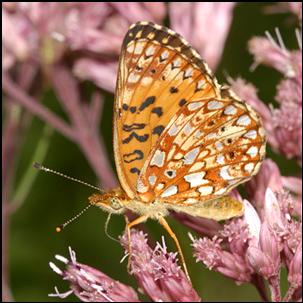
Photo: Longmeadow, Mass., Fannie Stebbins Wildlife Sanctuary, T. Murray, August 14, 2005
The two smaller fritillaries probably benefited from the clearing of land for pastures, haying and timbering in the 17th ,18th and early 19th centuries in southern New England (Table 1: 1600-1850). However, they did not benefit from the later increase in plowing, tilling and crop cultivation, since these practices destroy the host plant violets.
In the mid-1800s, the trend in New England agriculture was toward “improving” hayfields and pastures; this meant the plowing of fields and planting them with imported timothy and clovers, both of which were more nutritious for cattle than native forbs. It also meant ditching and draining the wetter areas, to make them plowable. Many colonies of Silver-bordered Fritillaries must have been lost during this time, because lance-leaved violet (Viola lanceolata) and most other native violets like blue marsh-violet do not survive plowing, cannot compete with aggressive timothy and clover, and do not recolonize easily on disturbed sites. But today, interestingly, hostplant violets have slowly re-colonized some of these old drainage ditches on farms, making the ditches good breeding habitat if they are not further disturbed.
After about 1900, there was also widespread loss of natural wetlands and farms to road-building and suburban development and from both these causes Silver-bordered Fritillary may have decreased here since 1850 (Table 2).
Thaddeus W. Harris had several specimens of Argynnis myrina in his 1820-50 collection . The earliest is "last of June, 1820", likely collected in Milton; others are June 15, 1833, Mt. Auburn, Cambridge, and August 1, 1833, Milton, Massachusetts (Index). Scudder (1862; 1889: 598) noted that myrina was found in moist meadows throughout New England, that it was “not very common,” and was found in June and again in August and September. It sometimes appeared in the Boston areas as early as May 27-30. F. H. Sprague reported that in 1878 it first appeared in Wollaston (Boston) on May 23 (Psyche 1879: 258). Scudder was interested in the long time period of emergences in the first brood, and the overlapping of the broods. “This insect passes the winter as a caterpillar, sometimes just from the egg, sometimes when half-grown. As a result of this difference in age, the first brood of butterflies straggles on in the spring instead of bursting upon us in swarms as is the case with some other species (1889:599)”
Specimens in the Harvard Museum of Comparative Zoology show that F. H. Sprague collected Silver-bordered Fritillary in 1883 from two locations in eastern Massachusetts, Wollaston (now Quincy, in Boston), and Malden, and two in the Connecticut valley, Deerfield and North Leverett. In 1878 he collected it in Belchertown as well (Psyche 1879: 259). Others collected it in Tyngsboro in 1916 and Weston in 1918. W. P. Atwood collected it in Lowell on 6/7/1891 (Wellesley Insect Colln). Specimens at Boston University show that it was collected in Auburndale (Newton) and Brookline (n.d., 1905-29, C. W. Johnson); North Reading (1909); Rehoboth (7/14/1914, H. Clark) and Bristol, R. I. (7/25/1913, H. Clark). It was collected in Stoneham by C. V. Blackburn (6/18/1929, Furman U.), and Stoughton (6/17/1930, Hagelstein, MCZ). Most surprisingly it was found on Martha's Vineyard (6/13/1917, C. W. Johnson, as well as 7/12/ 1928, F. M. Jones, BU), and Nantucket (2 specimens and a chrysalis, n.d., 1905-29, C. W. Johnson, BU).
By 1934 Farquhar characterised Silver-bordered as “general in damp places,” but does not list locations. (By contrast, he terms the Meadow Fritillary “common and general.”) In the 1930's and 1940’s Silver-bordered Fritillary was documented from Longmeadow and Granby (1938, no. coll, Yale); North Andover (Root and Farquhar 1948), and Blue Hills in Milton (1948, C. L. Remington, Yale). In 1950 it was found in Barnstable (8/4/1950, C. P. Kimball, MCZ), apparently the first specimen from Cape Cod.
From the 1960’s and 1970’s, the Yale Peabody Museum has many specimens from the towns of Acton, Concord, Littleton, Dover, Saugus, and Sturbridge. S. A. Hessel's two 7/2/1971 specimens from the foot of October Mountain in Lee document it for the first time from Berkshire County. There is a 8/20/1972 specimen from Cummington (no coll., MCZ). Mark Mello collected it in August 1960 in New Bedford. In 1966 through 1977, William D. Winter collected it in the Norfolk Co. towns of Millis, Medway, Dover and Westwood (specimens in MCZ). Oddly, Lepidopterists' Society 1959-1984 records do not make any mention of Silver-bordered Fritillary; Meadow Fritillary seems to have been the focus of interest. On the whole, museum and other records through the 1980s suggest that Silver-bordered Fritillary was widespread in mainland Massachusetts, but how common it was is uncertain.
Host Plants and Habitat
In Massachusetts, Boloria selene has most often been observed in close association with lance-leaved violet (Viola lanceolata), which is abundant in the wet meadows where the butterfly is found (Forster, 1986-90 Atlas; Mello and Hansen, 2004). This open, wet meadow violet is also the butterfly’s main host plant in Ohio (Iftner et al, 1992), and apparently on the coastal plain in New Jersey, where the butterfly is listed as a threatened species (Tudor and Gochfeld 2003; Wander and Wander 2009). Lance-leaved violet is native to, and found in, every county in Massachusetts (Sorrie and Somers 1999). It was very common around Concord in the 1850s; Thoreau mentions it many times in his journal (Angelo 1984).
Boloria selene probably also uses other species of violets. The 1995-9 Connecticut Atlas found Silver-bordered eggs or caterpillars in the wild on northern bog violet (Viola nephrophylla; in Massachusetts this violet is found only in Berkshire, Franklin and Hampshire Counties (Sorrie and Somers 1999), but it may be a host in those areas. Various authors mention V. cucullata, (blue marsh-violet), V. sororia, (common blue), and V. pallens (northern white violet) as possible hosts, all of which are also native to and found in every county in our state, but their use by Silver-bordereds has not been confirmed.
In the lab, the larvae will accept many species of violets, including the non-native V. odorata (sweet white) (O’Donnell et al. 2007), so that habitat preference rather than the precise violet species may determine the butterfly’s location in nature. The Silver-bordered Fritillary is not among the “Switchers” (Table 3). Unlike the Baltimore Checkerspot, another wet meadow species, it has not adopted any non-native host plants in the wild, and remains dependent on its native host violets and on relatively undisturbed wet meadow habitat.
In three northeastern states with good historical information, the Silver-bordered Fritillary is thought to be declining. For Ohio, Iftner, Shuey, and Calhoun (1992: 122) write “Once common throughout much of glaciated Ohio, this species has undergone a serious decline in abundance and distribution in recent years, probably because of habitat destruction.” “All known extant populations occur in open mesic habitats, and the loss of these habitats due to draining for agriculture and urban expansion may have eliminated this species from most of the state.” In New Jersey, Gochfeld and Burger (1997: 182) found that it “has apparently declined dramatically in the past 50-75 years.” W. Beutenmüller, in his 1893 catalogue of butterflies found within 50 miles of New York City, had considered it abundant in swampy places, and other early writers also considered it common; by contrast, it is now state-listed as a Threatened species and is restricted to a few small colonies (Wander and Wander 2009). In Connecticut, the 1995-99 Atlas found 25 project compared to 85 pre-project specimens, suggesting some decline, and lists Silver-bordered Fritillary among “grassland and meadow species that may be in decline” due to loss of open, early successional habitats (O’Donnell et al. 2007: 293). Cech (2005) notes that the species is “struggling in much of our area,” and that a single-brooded Maryland race is apparently extinct.
Our Silver-bordered Fritillary is identical to the species known as the Small Pearl-bordered Fritillary in Great Britain. Although still widespread in Scotland and Wales, the species has “undergone a severe decline” in England, and is on the verge of extinction throughout central-southern England due mainly to the spread of intensive agriculture, which destroyed most of its wet lowland habitat (Asher et al. 2001: 214-5).
Relative Abundance Today
The 1986-90 MAS Atlas found Silver-bordered Fritillary in 90 out of 723 total blocs. Using this measure (as we have for all species treated here) would rank this species in the Uncommon category. The Atlas broadly characterized it as “locally common,” though this phrase does not seem particularly apt, since the number of locations with large numbers is quite small (see below). MBC records 1992-2010 rank Silver-bordered Fritillary statewide as Uncommon.
A recent list-length analysis of MBC 1992-2010 data, published in the respected journal Nature: Climate Change, found a statistically significant 41.9% decline in detectibility of Silver-bordered Fritillary over these years (Breed et al. 2012). In this study all fritillaries in Massachusetts showed a decline except Great Spangled Fritillary.
Chart 44: MBC Sightings per Total Trip Reports, minus Cape Ann, 1993-2009
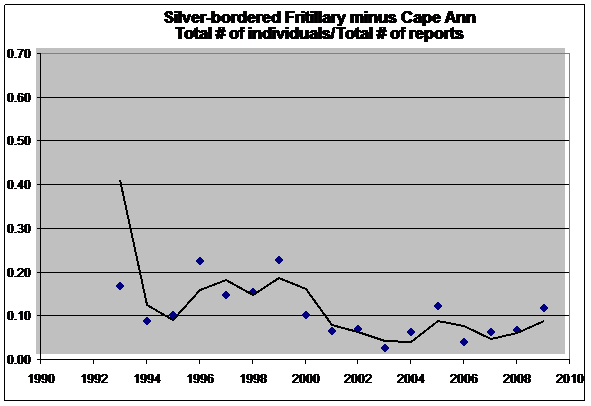
Chart 44 also suggests some erosion of numbers of Silver-bordereds since the highs of 1996-1999. However, the yearly variations since 1993 are not great, and reports from individual locations, and from the NABA Counts, are extremely variable, with some showing declines over this period, and some showing increases. For example, among the NABA counts in the state over these years, the Northampton Count (2001-2010) shows an increase in Silver-bordereds: only 5-10 found 2001-2004, but 31-36 in 2007, 2008, and 2009, and 16 in 2010. On the other hand the Northern Worcester Count shows a decrease: double-digits (10-66) reported in 1996, 1998, and 1999, but zero in 2009 and 2010.
The year 1992 has not been included in Chart 44 because of an atypical report of a large colony (150) in Stoughton, not adequately adjusted by the very small number of trip reports that year (1/4 as many as in subsequent years). No visits or reports of the Stoughton colony were made in any of the following years.
Records of Silver-bordered Fritillary on Cape Ann (Waring Field, Rockport) have also been excluded from Chart 44. This large colony is considerably overrepresented in MBC records, having been visited and counted multiple times a season for many years. In an attempt to gauge the status of Silver-bordered Fritillary more adequately across the state, the records from the Cape Ann colony are looked at separately.
At the Rockport Waring Field colony, counts were made every few days and weeks May through September in all years 1996 through 2008, by Doug Savich and Claudia Tibbits. The count schedule was frequent, but not always regular. In some cases, reports from other observers on similar dates are of the same order of magnitude as the numbers reported by Savich and Tibbits. The high counts for each year are shown below. They paint a picture of a healthy but highly fluctuating colony. No downward trend is apparent in these years, although 1998, 1999 and 2002 were poor years, perhaps because of intensive mowing. Mowing did not take place every year in this back field owned by the town of Rockport, but only every few years during this time period. (See site account by D. Savich in Stichter 2005).
Table 44: Yearly high count: Silver-bordered Fritillaries at Waring Field Rockport
9/15/1996 156 DS and CT
8/17/1997 266 DS and CT
6/6/1998 17 DS and CT
9/5/1999 20 DS and CT
9/17/2000 63 DS and CT
7/16/2001 342 DS and CT
7/23/2002 43 DS and CT
9/6/2003 1032 DS and CT
8/8/2004 558 DS and CT
8/8/2005 300 DS and CT
8/13/2006 855 DS and CT
9/14/2007 1300 DS and CT
6/12/2008 360 DS and CT
State Distribution and Locations
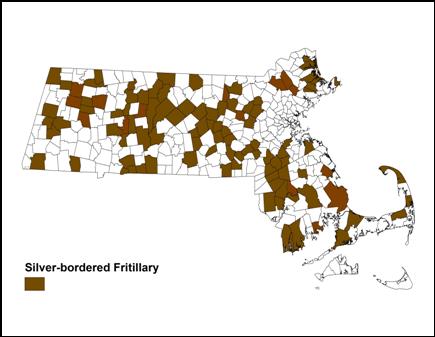
Silver-bordered Fritillary is well-distributed across the state, found in 105 out of 315 towns through 2013 (Map 44). It is found on Cape Cod, but has not been recently reported from either Martha’s Vineyard or Nantucket. The Atlas found Silver-bordereds only sparingly in Berkshire County, the western "hill towns," and the Worcester plateau, but BOM-MBC records provide many more locations in western Massachusetts and the central areas of the state, filling in many of the “apparent gaps” reported by the Atlas.
Map 44: BOM-MBC Sightings by Town, 1992-2013
On Martha’s Vineyard in the 1940’s Jones and Kimball (1943) reported that this species was “regularly present in suitable areas throughout the island, though rarely abundant.” Three specimens from Martha’s Vineyard, collected by F. M. Jones in the 1940’s, are now in the Yale Peabody Museum. But the 1986-90 Atlas did not find it on that island, and today’s Vineyard checklist ranks Silver-bordered Fritillary as “rare or extirpated,” with no recent records (Pelikan 2002). Why it should have died out on the Vineyard is a mystery. Regal Fritillary and Meadow Fritillary are also extirpated from Martha's Vineyard.
On Nantucket Silver-bordered Fritillary was also “moderately common in wet meadows and boggy places” in the 1940's (Jones and Kimball 1943), and Scudder (1899: 599) reports it from that island. But recent searches on Nantucket have not found this species , and some think it is probably extirpated (LoPresti 2011). If Silver-bordered Fritillary is indeed gone from both Martha’s Vineyard and Nantucket, that would constitute a significant range contraction in the last 70 years (since 1940).
On Cape Cod, Silver-bordered Fritillary may be declining. The 1986-90 Atlas did not find it there, except for a well-known colony in Provincetown/Truro (which has declined recently). MBC has additional reports, though of small numbers, from the towns of Brewster, Eastham, Sandwich, and Falmouth. Mello and Hansen (2004) say that meadows in, or adjacent to, natural and formerly cultivated cranberry bogs are the prime habitat for Silver-bordereds on Cape Cod. However, neither Cape Cod nor Plymouth County has as many Silver-bordered Fritillary reports as one might expect.
In Berkshire County Silver-bordered Fritillary is less common than in most other mainland areas of the state, but it is not “absent,” as the Atlas reported. It is regularly found on the Southern Berkshire NABA Count, although only in small numbers. MBC records show small numbers also reported from the towns of Washington, Lee (near October Mountain SF and Hop Brook), Lenox, Windsor, Savoy, and Williamstown. It is also found in nearby Plainfield, Cummington, Worthington, and Ashfield.
The larger known locations for Silver-bordered Fritillary in MBC records have been Rockport Waring Field, most recent high 360 on 6/12/2008 D. Savich; Ipswich/Hamilton Appleton Farms TTOR, 56 on 8/30/2011, R. Hopping et al.; Provincetown Evans Field, 50 on 9/18/2001 A. Robb and T. Hansen, but "overgrown" and 0 found in 2012; Athol, 53 on 9/13/1998 D. Small; and Upton Chestnut Street Gas Line, 32 on 7/18/1999, T. Dodd;
Smaller locations are Belchertown Quabbin Park, 10 on 6/10/2007 R. and S. Cloutier, 23 on 7/25/1999 M. Lynch; Concord NABA, regularly 1990-2004, none after that; Dartmouth Lucy Little Rd, 9 on 7/24/2010, M. Mello; Duxbury Bay Farm, 4 on 7/10/2013, B. Bowker; Groton Surrenden Farm, 13 on 6/10/2008 T. Murray; Hampden Laughing Brook WS, 6 on 7/20/2002 K. Parker; Hubbardston Ware River Watershed DCR, 20 on 5/22/2013, W. Howes; Longmeadow Fannie Stebbins WMA, 4 on 8/14/2005 T. Gagnon, K. Parker et al.; Mattapoisett Nasketucket SR, 5 on 8/2/2012, G. Trenholm; Milford power line, 9 on 9/8/2002 E. Nielsen; Milton Fowl Meadow, 6 on 7/21/2001 D. Peacock; Newburyport Plum Island, 11 on 9/13/2005 S. Stichter; Royalston Tully Dam, 6 on 5/23/2010 C. Kamp and A. Mayo; Sharon Moose Hill Farm TTOR, 5 on 7/25/2009 E. Nielsen; Sudbury Great Meadows NWR, 8 on 7/11/2009 S. Stichter; Wendell 10 on 7/25/2010 C. Kamp; Ware Klassanos property, 16 on 9/6/2010 B. Klassanos; Windsor No Name/Hume Rd., 5 on 7/19/2012, T. Gagnon.
Broods and Flight Time
According to 1992-2008 MBC records, Silver-bordered Fritillary has a long flight period, from mid-May to mid-October (http://www.naba.org/chapters/nabambc/flight-dates-chart.asp). At least two broods are reflected in this statewide flight pattern, with peaks in late July and again in September. But there may well be three overlapping broods in some parts of the state, as suggested by the Cape Ann data and by the MAS Atlas, though this remains to be fully demonstrated. (Three broods have been documented in the Delaware Valley and in Virginia (Opler and Krizek 1984). Most of the large numbers reported in September in Massachusetts come from the colony in Rockport on Cape Ann (see Table 44 above). We know very little about monthly fluctuations in any other colony.
During the years for which there are data (1996-2008), the Cape Ann colony was visited throughout the season, and exhibited larger numbers at three time periods: usually, mid-June, late July, and late August-mid-September. Impressionistically, three population bulges seemed apparent in most but not all years, but their timing varied. Also, the mid-September population bulge did not occur in all years.
Earliest sightings: In the twenty-three years of BOM-MBC records 1991-2013, the six earliest "first sightings" of Silver-bordered Fritillary are 5/6/2010 Middleton power line, M. Arey; 5/7/2012 Hubbardston, W. Howes (and Royalston, C. Kamp); 5/11/2013 Ipswich Appleton Farms, M. Arey; 5/11/2003 Longmeadow Fannie Stebbins WS B. Bowker; 5/14/2001 Cape Ann, D. Savich and C. Tibbits; and 5/14/1999 Royalston C. Kamp. Thus, the species was first seen in the second week in May (prior to 5/15) in six of the 23 years. Four of these early sightings have been in recent years: the warm springs of 2010 and 2012 produced new early record sightings those years. Another five "first sightings were in the third week (5/15 - 5/21) of May.
The occurrence of first sightings in the second and third week of May in eleven of the last twenty-three years seems to represent an earlier onset of the flight period than Scudder reported a century ago. He reported that the first specimens taken around Boston were on May 27, 28, and May 30; Sprague reports his first Boston sighting on May 23, 1878 (Sprague 1879). “Its usual appearance about Boston is in the early part of the last week in May....(Scudder 1889: 599).” There were apparently no reports (and no museum specimens) earlier than May 23 in the 19th century.
Latest sightings: In the same 23 years of BOM-MBC records 1991-2013, the six latest "last sightings" have been 10/12/2000 Cape Ann (Rockport), D. Savich and C. Tibbits; 10/11/2003 Cape Ann (Rockport), D. Savich and C. Tibbits; 10/9/2011 Ipswich Appleton Farms, R. Hopping; 10/8/2004 Cape Ann (Rockport), D. Savich and C. Tibbits; 10/8/1995 Milford, R Hildreth; and 10/6/2012 Newbury, M. Arey.
The Silver-bordered Fritillary flight has stretched into October in ten of the twenty-three years under review. Often, the colonies in Rockport or Ipswich provided the last sighting of the year, possibly owing to the warming effect of the ocean on fall temperatures. The last sightings are typically of only 1 or 2 butterflies. Earlier sources (e.g. Scudder 1889, Harris 1862, MAS Atlas 1986-90) do not mention any October sightings, so these reports may represent a lengthening of the “tail” of the flight period.
Outlook
The serious decline of Silver-bordered Fritillary in Ohio, New Jersey, Connecticut, and England (see above), and its retreat from the Massachusetts islands, should alert us to the fragility of this species. The major threat is habitat loss, as well as degradation of wetland habitat. A second looming factor is climate warming; most of the states experiencing loss and decline of this species are on the southern edge of its range, e.g. Maryland, Virginia and New Jersey (see map in Cech and Tudor 2005).
Silver-bordered Fritillaries do not seem to have adapted to dry or disturbed habitats. Compared to the Meadow Fritillary, which uses both wet and dry meadows, Silver-bordered prefers only wet meadows. Many wet meadows are vulnerable to natural succession, and must be mowed to prevent shrubs from shading out the lance-leaved violet, as has apparently happened at Evans' Field in Provincetown. The species of violets used as host plants in different areas should be more precisely determined.
All colonies of Silver-bordered Fritillaries in our state, whether large or small, should be monitored and conserved. All Massachusetts fritillary species except the Great Spangled have already suffered some historical decline and retrenchment, and all are sensitive to climate warming (Table 6). Hopefully, greater conservation awareness will protect the lovely Silver-bordered from further decline.
© Sharon Stichter 2011, 2012, 2013, 2014
page updated 1-7-2014
ABOUT BOM SPECIES LIST BUTTERFLY HISTORY PIONEER LEPIDOPTERISTS METHODS