ABOUT BOM
SPECIES LIST
BUTTERFLY HISTORY PIONEER LEPIDOPTERISTS
METHODS
The Butterflies of Massachusetts
27 Henry’s Elfin Callophrys
henrici (Grote and Robinson, 1867)
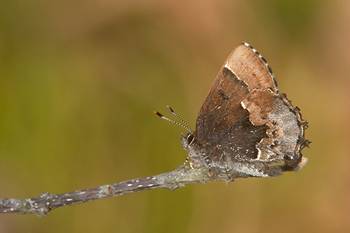 Charming
and adaptable, Henry's Elfin uses a variety of habitats, and different host
plants in different geographical areas. It has even added alien buckthorns (Rhamnus
spp.) to its diet, a change which has allowed it to increase its numbers in New
England. Henry’s Elfin has a wide range in eastern North America, from southern
Canada to Texas and Mexico.
Charming
and adaptable, Henry's Elfin uses a variety of habitats, and different host
plants in different geographical areas. It has even added alien buckthorns (Rhamnus
spp.) to its diet, a change which has allowed it to increase its numbers in New
England. Henry’s Elfin has a wide range in eastern North America, from southern
Canada to Texas and Mexico.
Henry’s Elfin was routinely confused with
Frosted Elfin and
Hoary Elfin by early lepidopterists. Scudder, along with others in the
nineteenth century such as Godart, described something called Incisalia irus,
which could have included any of the three elfins mentioned, not just Frosted.
Recently, much of Scudder’s description of irus has been determined to be
a description of Henry’s Elfin rather than Frosted Elfin.
Photo: Chelmsford, Mass.
Concord Road power line, T. Whelan, April 2004
The original descriptions of the larva and pupa of “C.
irus” are found in Boisduval and Le Conte (1829 [1837]), but they are from
John Abbot’s notes and figures, which Calhoun has shown are actually of C.
henrici (Calhoun 2004). Scudder's (1889) descriptions of the second, third, and fourth-instar
larva, pupa, larval hosts, and feeding habits of “C. irus” are taken from W. H. Edwards’ notes on C. henrici, and the larva
and pupa figured in Scudder are reproduced from Abbot’s drawings of C.
henrici in Boisduval & Le Conte (Calhoun 2004; Albanese et al.,
2007b).
As a result of this early confusion, we know hardly anything
about the abundance or distribution of Henry’s (or Frosted or Hoary) in
Massachusetts at the turn of the century, except that all three species were
thought of as rare. But through retroactive museum determinations, we can be
reasonably certain that there were at least two pre-1900 locations for Henry’s
Elfin in the state: Waltham and Wollaston. (Frosted and Hoary Elfins were also
found in Waltham prior to 1900.) There are at least ten 1897 specimens in the
MCZ and the AMNH, taken in April and May in Waltham by C. Bullard, and three specimens in the MCZ retroactively labeled Henry’s collected in Wollaston (Quincy) in 1878 and 1897 by F. H. Sprague.
There were also several locations for Henry’s Elfin in
eastern Massachusetts between 1900 and 1950, as indicated by museum specimens,
and then a great increase in reports and locations beginning in the 1960’s.
Examination of a large dataset of Massachusetts elfin museum specimens reveals
that for eastern Massachusetts there are retroactively-identified 1900-1950 specimens from
Concord (1914, W. Reiff, SI), Wayland (1920, 1921, C. J. Paine Coll. MCZ), and
Sudbury (1926, C. J. Paine Coll. MCZ), and many specimens from Fall River in the
1930's and 1940's (1930-1935, W. P. Rogers, AMNH; 1943, 1944,
1946, D. J. Lennox, UNH; 1948, W. P. Rogers, Yale). The number of locations
is smaller than the number of locations for Frosted Elfin or even Hoary Elfin
for this time period.
The first report for Cape Cod appears to be a 1952 specimen
from Barnstable (C. P. Kimball collection) in the Harvard MCZ. There are no
reports from the Islands, as there were for Frosted and Hoary Elfins. Jones and
Kimball (1943) do not record Henry's Elfin as present on Martha's Vineyard or
Nantucket, and it is still not found there today.
Reports and specimens of Henry’s Elfin expand dramatically
in the mid-1960’s, probably reflecting the adoption of buckthorns as host
plants. In May 1964 J. D. Turner captured a specimen in Sherborn,
which is now in the McGuire Center in Florida. In May 1965 Charles G. Oliver
took a female specimen in North Acton on May 6, which he thought [erroneously] “may be a
new record for Middlesex County, Mlassachusetts.” That specimen is now in the
Yale Peabody museum. Another capture was reported June 1, 1966 in Framingham,
by J. W. Cadbury and C. Curtis. The first report for Essex County, and a bona
fide new
record there, came in 1967, when James P. Holmes captured 2 males and a female
on May 21, 1967, and another female on May 28, all in the town of Essex. He
says that these 1967 finds are his “first personal record of this scarce
species.” He found another the next year, 1968 and another in 1971 (LSSSC
1965-71). Holmes had collected intensively on Cape Ann for two years prior to
1967, and not found this species.
The first report for the Connecticut River valley area
comes in 1963, with a specimen, now in the MCZ, taken on June 3 in the
vicinity of Mount Tom, north of Holyoke, by John M. Burns, E. Hanson and D. Hottenstein. The species may still have been uncommon in that region, because P. Carey did not find
it, despite collecting in the Springfield and Mt. Tom areas in 1972 and 1973.
The 1970’s were punctuated by more finds in eastern
Massachusetts south and west of Boston. J. Ingraham found Henry’s Elfin in
Needham, Dover and Dedham in 1973 (Yale, MCZ, LSSSC 1973). Dave Winter found it in
Needham in 1973 and Wellesley (Babson Park) in 1974 (MCZ and AMNH specimens).
And D. Willis reported Henry’s Elfin as a “new species” in the
Holliston-Sherborn-Framingham area in 1974 (LSSSC 1974; location probably the
Sherborn power line). After 1974, the Babson College site in Wellesley became a
favored collecting location, and there are
many Wellesley specimens extant: 1976 W. Winter (LSSS); 1974, 1976, 1977, 1980,
R. Robbins (Smithsonian); 1979, 1980, E. Williams (pers. coll.); 1984, R.
Godefroi (McGuire). In 1979, R. Busby reported Henry’s Elfin from Needham and
North Reading (LSSSC 1979). In 1980, C. Shiffer collected a specimen in the
Blue Hills Reservation (Milton and Canton) (McGuire).
In 1985, the dramatic discovery that Henry’s Elfin had
switched to introduced aggressive buckthorns was made at the Wellesley site by
Dale Schweitzer (see below). Henry’s Elfin appears to have increased in
eastern Massachusetts since about 1965, probably as a result of its adoption of
this widespread plant, and is so listed on Table 2.
Host Plants and Habitat
Throughout its wide geographic range Henry’s Elfin uses a
number of different host plants, but usually only one or two in any given area.
On the mid-Atlantic east coast the two main hosts are Redbud (Cercis
canadensis) and American Holly (Ilex opaca). The redbud-feeding
populations are mainly in rich forested areas inland and in the Appalachians,
while the holly-feeding populations are along the coastal plain, especially New
Jersey north to Rhode Island. But Massachusetts is north of redbud’s historic
range, and American Holly is found here mostly on Cape Cod and the Islands.
Massachusetts is where Henry’s
Elfin was first shown to have switched to exotic, aggressive buckthorns, both
Rhamnus frangula (=alnus) and R. cathartica, as host plants. Today buckthorns are probably its most common host here. In 1985 Dale Schweitzer
first reported from a site in Wellesley that females commonly sat among thickets
of R. frangula, and several ovipositions were observed on the flower
buds. Photos by Dave Winter of the larvae on R. frangula in Wellesley in
July 1985 are in the MBC slide collection (click here to
see one photo). At the same location, females did not
rest on or oviposit on 3-4 abundant species of blueberry. The larvae ate
blossoms and berries of Rhamnus, even the foliage, and successfully
pupated. In another nearby area studied by Schweitzer, there was no other
likely native food plant around except Nemopanthus[Ilex] mucronata, or
mountain-holly, which was abundant and in Schweitzer’s view was the most
plausible candidate for a native, pre-Rhamnus food plant there (News of
the Lepidopterists Society, 1985; Kirk 2003; Stichter 2011).
Thus the original native host plant in Massachusetts may not have been
American Holly but the closely related Nemopanthus mucronata, or Common
Mountain-holly (Schweitzer, Lep.Soc.Seas.Sum. 1985; Kirk 2003). This species is
used as a host plant in New Brunswick, and was abundant near the site where
Henry’s was first discovered using the introduced Rhamus spp. On the
other hand, the original native host might have been blueberry (Vaccinium)
and huckleberry (Gaylussaca) species, which are also common hosts in
Canada (Kirk 2003). There is very little actual evidence for Massachusetts.
Scudder thought the native host plant was Vaccinium. In Rhode Island, the
species probably uses American Holly, since it is usually found associated with
it, but it is also found in areas without holly (Pavulaan, quoted in Kirk 2003).
Mello and Hansen thought that Henry’s Elfin might use Ilex on Cape
Cod (Mello and Hansen 2004), but there is no real evidence.
Henry’s Elfin is one of a surprising number of butterfly
species which have switched to non-native hosts during historical times, and may
be the only local elfin to have done so (Table 3).
It uses Rhamnus both in our area and in Ontario and Nova Scotia and
perhaps other areas. The switch has been coincident with an increase in the
abundance of this species (Layberry et al. 1998).
Henry’s Elfin does not make as much use of open areas as do
other elfins, being found usually in forests, forest edges, or tall shrub swamps
where one of its host plants is present.
Relative Abundance Today
The Atlas found Henry's in only 29 of the 723 blocs searched,
making it “Uncommon.” MBC reports 2000-2007 rank it similarly, at the lower end
of “Uncommon” (Table
5). It is not as frequently reported as Hoary Elfin, but Table 5 does not
include the post-2007 increases in sightings. Henry’s is reported from a larger
number of towns, and is more widely distributed, than Hoary (see map below).
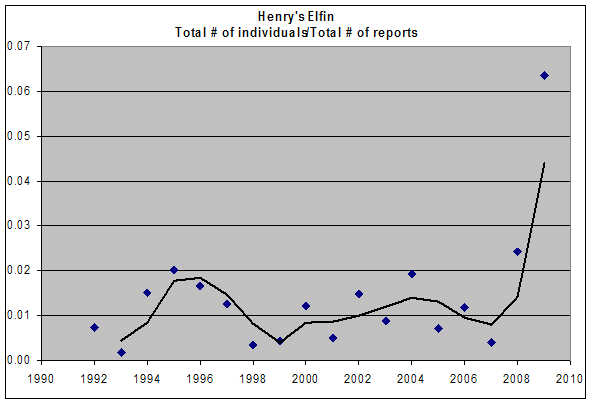
Henry's Elfin is probably increasing in Massachusetts. There is an upward trend in MBC sightings of
this species,
1992-2009 (Chart 27), which is most evident in 2008 and 2009. Until then,
fluctuations every few years seemed to be the norm.
Chart 27: MBC
Sightings per Total Trip Reports, 1992-2009
A similar finding comes from a list-length
analysis of these same MBC data, which showed a statistically significant 175%
increase in detectibility for Henry's Elfin over the 1992-2010 period (G. Breed et al. 2012).
Further illustration of the trend comes from statistics published in the Massachusetts Butterflies
Season Summary: the average number of Henry’s Elfins seen on
a trip in 2007 was down 60% compared to the average for preceding years back to
1994, but was up 126% in 2008, and 386% in 2009 (Nielsen 2008, 2009, 2010).
The large increase in 2009 is mainly due to one report of 25
from Fowl Meadows in Milton. While this report is probably a good estimate, it
is the first report in MBC records to exceed 8 at any one site. Even excluding
that report, the trend through 2009 is still upward. The years 2010, 2011 and
2012 saw continued increase in the total numbers of Henry's Elfins reported,
though fuller analysis remains to be done.
State Distribution and Localities
Henry’s Elfin is found almost solely in the eastern part of the state
and around the Quabbin Reservoir in central Massachusetts. There have been very few
found on Cape Cod, none on the islands, and none in Berkshire County (Map
27).
Henry's Elfin has not been found 1991-2013 in the
Berkshires, either north or south, or in nearby western towns, except for one
report of a single 5/25/1998 in Heath, D. Potter, which is shown on the map but
is uncertain and needs reconfirmation. Nor did the 1986-90 Atlas find this
species in the Berkshires. There are apparently three specimens from
the 1950's labeled "Henry's Elfin, Tyringham" in the Berkshire Museum, but the
August dates are not within the flight period for this species, so these cannot
be accepted without further explanation. Henry's Elfin is also not reported from the northern
Connecticut River valley.
Map 27: BOM-MBC
Sightings by Town, 1991-2013
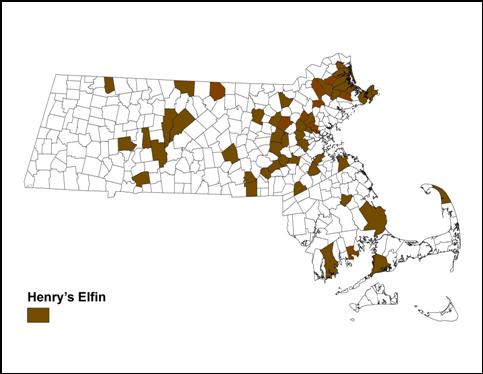
Map 27 greatly extends the limited
distribution shown in the 1986-90 MAS Atlas. MBC reports now extend the
range into the central area of the state around Quabbin
Reservoir, and into the southern Connecticut River valley. It is not clear whether the butterfly’s range expanded
since the Atlas years, or whether more intensive searches are the cause, but
range expansion is likely. The Atlas had no reports from central Massachusetts,
but there are multiple MBC reports from Worcester, Petersham, New Salem, and
Belchertown. For the southern "valley" towns, the Atlas had a single
report from Hampden (4/24/1990, K. Parker), to which MBC records add a few more
reports from Springfield, Northampton, and especially Amherst.
The Atlas had only one report from Cape Cod, from Mashpee. MBC reports now show Falmouth (Crane WMA) and Truro (Pilgrim Heights) to be good
locations for Henry’s Elfin. Mello and Hansen (2004) suggest several other possible
locations, but call the species elusive on the Cape. It apparently has not been found at Ashumet Holly Reservation in Falmouth, despite the presence of a possible host
plant. Henry's Elfin still has not been reported from either
Martha's Vineyard (Pelikan 2002) or Nantucket (LoPresti 2011).
If we compare these MBC reports to the locations known for
Henry’s Elfin in the 1970s and 1980s, both prior to and during the Atlas, a marked expansion in the
geographical distribution (range) and number of towns is apparent. Map 27
shows MBC reports from 53 towns; MBC records for the same time period show
Frosted Elfin from 37 towns and
Hoary Elfin from only 10 towns. Compared with
these other two elfin species, Henry's is found in a greater number of towns,
and by this
measure is the most abundant of the three elfins.
Productive sites and high counts for Henry’s Elfin have been
Acton Fort
Pond Brook, 8 on 4/26/2008 J. Forbes; Falmouth Crane WMA, 2 on 5/21/2011 A.
Robb; Harvard Oxbow NWR, 4 on 5/3/2003 T. Murray and E.
Nielsen; Ipswich Willowdale SF, 5 on 5/11/2002 F. Goodwin; Lexington Arlington's Great Meadow, 6 on
4/29/2012 T. Whelan et al.; Medford Middlesex Fells, 3 on 5/7/2011, M. Arey; Milton Fowl
Meadows, 25 on 4/24/2009 S. Jaffe, 8 on 4/28/2013 R. and S. Cloutier; Newbury Old Town Hill TTOR, 2 on
4/22/2008 S. Stichter; Newburyport Plum Island, 2 on 4/20/2004 R. Heil, and 2
on 5/15/2004 C. Kamp (MAS Atlas lists a high of 8 on 30 April 1994, Plum Island);
Sherborn power line, 7 on 5/7/2011 B. Bowker et al.; and Truro
Pilgrim Heights, 5 on 5/7/2000, A. Robb.
Broods and Flight Times
Henry’s Elfin is single-brooded throughout its wide
continental range, flying for a little over a month. The onset of flight is
earlier in southern regions; for a comparison of flight periods in different
regions, see Kirk 2003.
In Massachusetts Henry’s Elfin flies mainly from mid-April to the
end of May according to 1993-2008 MBC records (http://www.naba.org/chapters/nabambc/flight-dates-chart.asp).
There is no information from Scudder on flight dates in the 19th century due to
the confusion over species identification.
Earliest Sightings: In the 23 years 1991 through 2013,
the four earliest "first sighting" dates
are 3/23/2012 Georgetown power line, M. Arey; 4/4/2010 Plum Island, E. Nielsen;
4/13/2002 Plum Island, B. Walker; and 4/15/2000 Topsfield Ipswich
River WS, F. Goodwin. The Atlas also reported an early date of 4/15/1986
Wilmington, S. Goldstein. Interestingly, all of the early reports are from
Essex County. In 15 of the 23 years under review (1991-2013), the first butterflies were reported on
or before April.24.
Henry’s, Hoary and Frosted Elfins generally appear about the same time, with
Frosted peaking a little later than the other two.
Latest Sightings: In the 23 years 1991 - 2013
the four latest "last sighting" dates are
6/8/1997 Falmouth Crane WMA, J. Sones; 6/7/2009 Holliston Brentwood CA, B. Bowker;
6/6/1999 Falmouth Crane WMA, A. Robb; and 6/4/2011 Newbury Martin Burns WMA , S.
and J. Stichter. These are the only June "last sighting" dates in this period; in
the rest of the years, the last sighting date was in the third or fourth week of May, not in June.
The Atlas had reported a similar June last sighting date, 6/7/1988, North
Dartmouth, M. Mello.
Flight Advancement: Unlike Brown Elfin and Eastern Pine Elfin, Henry's Elfin
does not seem to have advanced its flight time significantly during the years
1986-2009, according to a 2012 study done at Boston University using MBC and
Atlas data (Polgar, Primack, et al. 2013). However, later
calculations using 1986-2012 data showed significant flight
advancement by Henry's Elfin: about 12 days over this period (Williams et al.
2014). Like
most elfins studied, Henry's Elfin also shows a statistically significant response of
flight time to temperature variations in the two months prior to
emergence (March, April), varying its flight time by 3.86 days for every ºC
change in average spring
temperature. This responsiveness to temperature is an adaptive trait.
Outlook
Because of its use of aggressive and widespread buckthorns
as host plants, Henry’s Elfin is expected to become more common in
Massachusetts. In addition, as a largely southern-range species, Henry’s Elfin may
continue to increase in numbers and range in this state due to climate warming (Table
6). Its present NatureServe rank in the state is S4, or apparently secure.
Interestingly, in Connecticut, Henry’s Elfin’s rank is only
S2S3, and it had not been found in the state for some 30 years prior to the
start of the Atlas in 1990. Only 3 project and 4 pre-project specimens were
found, and it is not clear what the host plant is in wild (O’Donnell et al.
2007).
© Sharon Stichter 2011, 2012, 2013
page updated 12-26-2013
literature cited
ABOUT BOM
SPECIES LIST
BUTTERFLY HISTORY PIONEER LEPIDOPTERISTS
METHODS
